Understanding the Catholic Rite of Marriage
Catholic marriage, a sacred union, unfolds through a defined rite, detailed in resources like the Catholic wedding PDF guides, emphasizing consent and blessing.
Historical Development of the Rite
Historically, the Catholic rite of marriage evolved from early Christian practices, initially informal celebrations focused on mutual consent. Over centuries, liturgical elements were gradually incorporated, influenced by Roman legal traditions and evolving theological understandings.
Early Church documents, alongside resources like the rite of marriage Catholic PDF guides, reveal a progression towards formalized ceremonies. The Council of Trent (1545-1563) significantly standardized the rite, emphasizing sacramental validity and clarifying essential elements.
Subsequent papal decrees and liturgical reforms continued to shape the rite, balancing tradition with contemporary pastoral needs.

Theological Foundations of Catholic Marriage
Catholic theology views marriage as a sacrament instituted by Christ, symbolizing the union between Christ and the Church. It’s rooted in the biblical creation narrative, emphasizing the complementary nature of man and woman and their call to procreation and mutual aid.
The rite of marriage, detailed in Catholic PDF guides, reflects these beliefs. Marriage isn’t merely a contract but a covenant, an unbreakable bond reflecting God’s faithful love.
Sacramental grace strengthens spouses to live out this vocation, fostering fidelity, love, and commitment.
Pre-Canonical Investigations
Before a Catholic marriage can be celebrated, a pre-canonical investigation, outlined in rite of marriage PDF resources, is essential. This process verifies the freedom of both parties to marry according to Church law.
It confirms that no impediments exist – prior bonds, disparity of cult, or consanguinity. The parish priest diligently gathers documentation and interviews potential spouses.
This careful inquiry ensures the validity of the sacrament and protects the sanctity of marriage.
Purpose of Pre-Canonical Inquiry
The primary purpose of the pre-canonical inquiry, detailed within Catholic rite of marriage PDF guides, is to establish the canonical freedom of prospective spouses. This ensures both individuals are eligible to enter sacramental marriage according to Church law.
It aims to uncover any hidden impediments—existing marriages, close familial relationships, or discrepancies in religious belief—that would invalidate the union.
Ultimately, it safeguards the sacredness and validity of the marriage.
Documents Required for Investigation
Catholic rite of marriage PDF resources outline essential documentation for pre-canonical investigation. These typically include baptismal certificates (with notations), confirmation certificates, and declarations of freedom to marry from each party;
Civil divorce decrees (if applicable), death certificates of previous spouses, and any relevant canonical dispensations are also required.
Parish priests utilize these documents to verify eligibility and ensure a valid marriage.
The Three Forms of the Marriage Rite
Catholic rite of marriage PDF guides detail three liturgical forms. First, marriage within Mass, fully integrated with the Eucharistic celebration. Second, marriage outside Mass, including Communion, offering a more intimate setting.
Lastly, marriage outside Mass, without Communion, suitable when circumstances prevent receiving the Eucharist. Each form emphasizes the exchange of vows and nuptial blessing, reflecting the sacredness of the union.
Marriage within Mass
A Catholic rite of marriage PDF explains this form integrates the sacrament fully into the Liturgy of the Word and Eucharist. It’s often favored by couples deeply involved in the Church.
The exchange of vows occurs after the homily, before the Eucharistic Prayer, signifying the couple’s commitment within the broader community of faith. This form highlights the unity of marriage with Christ’s sacrifice.
Marriage Outside of Mass, with Communion
A Catholic rite of marriage PDF details this option, celebrated with a Liturgy of the Word, readings, and a homily focused on the sacrament’s meaning. It’s suitable when a full Mass isn’t feasible or desired.
Crucially, the couple receives Holy Communion during the celebration, signifying their spiritual union with Christ and the Church. This form maintains a strong Eucharistic connection, though less integrated than within Mass.
Marriage Outside of Mass, Without Communion
As outlined in a Catholic rite of marriage PDF, this form involves a Liturgy of the Word, readings, and a homily, but excludes the celebration of the Eucharist. It’s permissible when circumstances prevent Communion, or at the discretion of the pastor.
While lacking the Eucharistic connection of other forms, it still emphasizes the sacredness of the vows and the couple’s commitment. It’s a valid option, though less complete sacramentally.
Essential Elements of the Rite of Marriage
According to a Catholic rite of marriage PDF, two core elements define the sacrament: the free and mutual exchange of consent, and the nuptial blessing invoked by the priest or deacon. These aren’t merely formalities; they are the sacrament itself.
Without valid consent—a clear, willing choice—no marriage exists. The blessing consecrates the union, invoking God’s grace upon the couple, solidifying their bond and future together.
Exchange of Consent
A Catholic rite of marriage PDF clarifies that the exchange of consent is paramount. It’s the moment the couple freely and knowingly establishes the marriage bond. This isn’t simply saying “I do”; it’s a profound declaration of their will to commit to each other for life.
Consent must be given publicly, before the priest and two witnesses, demonstrating the couple’s intention to enter into a lifelong, exclusive union open to procreation, as outlined in Church doctrine.
The Nuptial Blessing
A Catholic rite of marriage PDF details the Nuptial Blessing as a crucial element, invoking God’s favor upon the newly married couple. The priest, acting in persona Christi, beseeches blessings of joy, fidelity, and fruitfulness.
This blessing isn’t merely a wish, but a sacramental prayer strengthening the couple’s love and preparing them to fulfill their vocation. It signifies God’s active presence in their union, solidifying their commitment.
Roles of Participants in the Ceremony
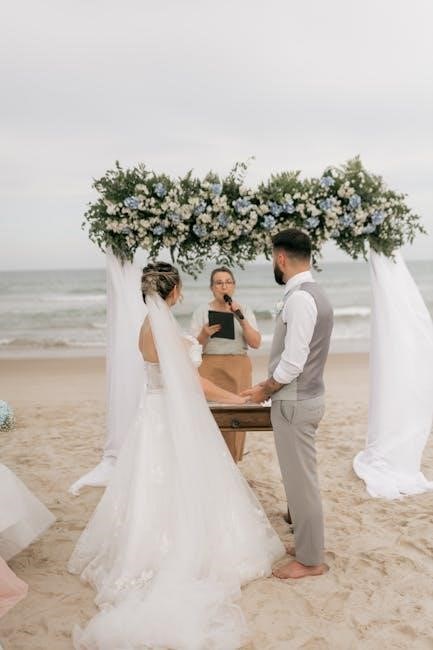
A Catholic rite of marriage PDF outlines distinct roles. The priest or deacon presides, ensuring the ceremony adheres to Church law and offering guidance. The bride and groom freely exchange consent, forming the sacrament’s core.
Witnesses, typically family and friends, publicly attest to the vows. Their presence validates the marriage. Each participant contributes to the sacredness of the event, creating a communal celebration of love and faith.
The Priest or Deacon
According to a Catholic rite of marriage PDF, the priest or deacon acts as the official Church witness. They bless the couple and lead the liturgical celebration, ensuring conformity with canonical requirements.
Their role involves verifying the couple’s freedom to marry and witnessing the exchange of consent. They offer prayers and guidance, emphasizing the sacred and indissoluble nature of the marital bond, solidifying the sacrament’s validity.
The Bride and Groom
As detailed in a Catholic rite of marriage PDF, the bride and groom are the central figures, freely exchanging vows—the core of the sacrament. Their mutual consent, publicly declared before God and the Church, establishes the marriage bond.
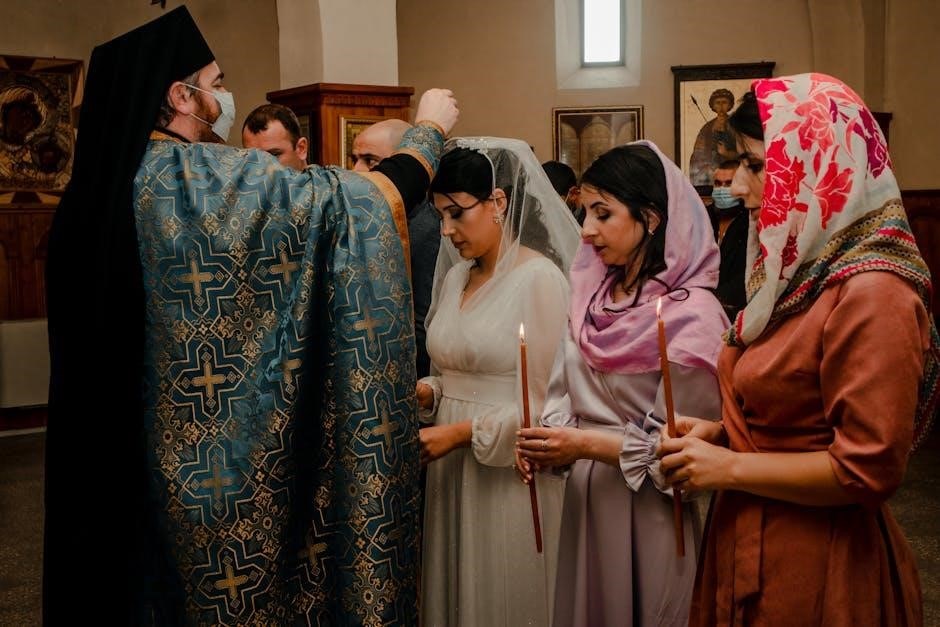
They demonstrate their commitment through participation in the liturgical celebration and reception of the nuptial blessing, signifying their entry into a lifelong covenant of love and fidelity.
Witnesses
According to a Catholic rite of marriage PDF, at least two witnesses are required for validity, publicly attesting to the couple’s consent. These witnesses, often family or close friends, represent the community’s acknowledgment of the marriage.
Their presence isn’t merely formal; they support the couple’s commitment and offer ongoing encouragement. They sign the marriage certificate, confirming they observed the exchange of vows, solidifying the sacramental act.
The Use of Symbols in the Catholic Wedding
A Catholic rite of marriage PDF highlights symbolic elements enriching the ceremony. Wedding rings, circles with no beginning or end, signify eternal love and fidelity. White garments traditionally symbolize purity and joy, representing the couple’s new beginning.
These symbols, deeply rooted in tradition, visually communicate the sacredness of marriage, enhancing the spiritual significance of the vows exchanged before God and the community.
The Wedding Rings
As detailed in a Catholic rite of marriage PDF, wedding rings are potent symbols. Their circular shape represents eternity, signifying a love without beginning or end. The act of placing the ring on the fourth finger of the left hand, historically believed to connect directly to the heart, emphasizes intimate connection.
Rings demonstrate a visible and tangible commitment, a constant reminder of the vows exchanged, and the enduring promise of faithfulness within the sacrament of marriage.
The White Garments
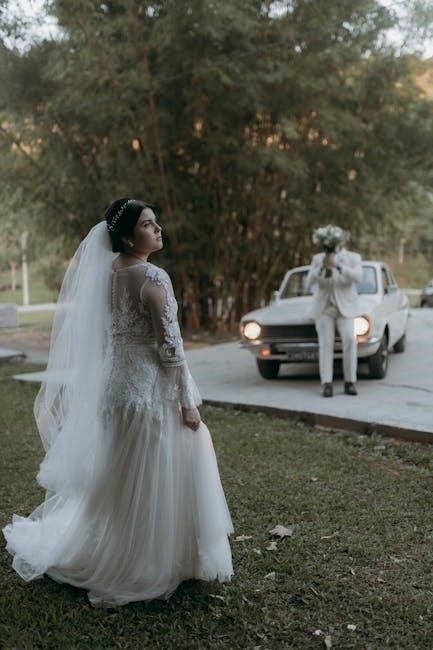
According to resources like a Catholic rite of marriage PDF, the bride’s white garments symbolize purity and joy. White represents the radiant joy of the occasion and signifies spiritual purity, reflecting a clean slate and new beginning within the sacrament.
Historically, white also symbolized wealth, but its modern meaning focuses on innocence and the bride’s readiness to embrace her vocation. It’s a visual representation of grace and commitment.
Marriage and Sacramental Grace
A Catholic understanding, detailed in a rite of marriage PDF, views marriage as a sacrament instituted by Christ. This sacred union bestows unique graces upon the couple, strengthening their love and assisting them in fulfilling their vocation. These graces aid in fidelity, perseverance, and raising children in the faith.
Marriage isn’t merely a contract; it’s a covenant offering divine assistance for lifelong commitment and mutual sanctification.
Marriage as a Sacrament
According to the Catholic Church, as explained in resources like a rite of marriage PDF, marriage is one of the seven sacraments. It signifies Christ’s union with the Church. This isn’t simply a symbolic gesture, but an outward sign instituted by Christ to give grace.
The sacrament confers a holy, indissoluble bond, reflecting God’s faithful love and offering graces for a lifelong commitment.
The Graces Received Through the Sacrament
A Catholic rite of marriage PDF details the graces bestowed upon couples. These aren’t magical powers, but gifts aiding their vocation. They include the grace to love each other as Christ loves the Church – unconditionally, sacrificially, and faithfully.
Further graces foster fidelity, perseverance in difficulties, and the ability to raise children in the faith, strengthening their mutual help and enduring love.
Canonical Requirements for Marriage
A Catholic rite of marriage PDF outlines strict canonical requirements. Both parties must be free to marry – no existing valid marriage. Age requirements vary by diocese, often needing parental consent for younger individuals.
Proper preparation, including marriage preparation courses, is essential. Both must understand the nature of marriage as a lifelong, exclusive union open to procreation, as detailed in Church law.
Age Requirements
A Catholic rite of marriage PDF specifies age stipulations. Generally, both parties must be at least 16 years old, with diocesan bishop’s permission for those 14-15. However, marriage under 16 requires a dispensation from the Holy See.
Parental consent is typically mandatory for those under 18. These requirements aim to ensure maturity and understanding of the lifelong commitment inherent in sacramental marriage.
Freedom to Marry
A Catholic rite of marriage PDF details the necessity of “freedom” – the absence of coercion. Both individuals must enter marriage willingly, without undue pressure from others. Canonical impediments, like prior valid marriage or certain degrees of consanguinity, also restrict this freedom.
Genuine consent, free from fear or deception, is paramount. Any lack of freedom renders the marriage invalid according to Catholic doctrine.
The Role of the Parish Priest
The parish priest, as outlined in a Catholic rite of marriage PDF, is central to the process. He oversees marriage preparation, ensuring couples understand the sacrament’s significance. He facilitates pre-canonical investigations and witnesses the exchange of vows, validating the marriage.
Priests also guide couples through required courses, confirming their freedom to marry and proper understanding of their commitments. Their role is vital for a valid celebration.
Marriage Preparation Courses
Catholic marriage preparation courses, detailed in rite of marriage PDF guides, are crucial. These programs, often facilitated by the parish priest, explore the theological foundations of marriage and practical aspects of married life.
They cover communication skills, conflict resolution, and responsible parenthood. Couples delve into the sacrament’s spiritual depth, ensuring a well-informed and faith-filled commitment, preparing them for lifelong unity.
Witnessing the Exchange of Vows
The priest or deacon, as the Church’s official witness, formally receives the couple’s consent—the heart of the Catholic rite of marriage, as outlined in PDF resources. This exchange, a solemn declaration of mutual love and commitment, establishes the sacrament.
Witnesses are also required, validating the public nature of the vows. Their presence confirms the couple’s freely given consent, solidifying the marital bond before God and the community.
Annulments and the Catholic Church
Catholic annulments, often misunderstood, aren’t dissolving valid marriages but declaring a marriage sacramentally invalid from its beginning, as detailed in rite of marriage PDF guides. Grounds include lack of free consent, or impediments.
The process, involving a tribunal, investigates the marriage’s history. If proven invalid, a decree of nullity is granted, allowing both parties to marry sacramentally within the Church. It’s a complex, pastoral process.
Grounds for Annulment
Catholic annulment grounds, explored in rite of marriage PDF resources, center on impediments existing at the time of consent. These include lack of due discretion, forced consent, or pre-existing bonds.
Essential capacity for sacramental commitment—understanding permanence and fidelity—is crucial. Psychological factors impacting free will, or concealment of grave issues, also qualify. The tribunal assesses if true consent existed initially.
The Annulment Process
The Catholic annulment process, detailed in rite of marriage PDF guides, begins with a petition to the diocesan tribunal. Evidence—testimonies, documents—is gathered to assess the marriage’s validity.
A judge and assessors review the case, often involving multiple phases. Witnesses are interviewed, and both parties have rights to present evidence. If a decree of nullity is granted, it affirms the marriage was invalid from its inception.
Recent Developments and Discussions
Recent discussions, reflected in updated rite of marriage PDF resources, center on Fiducia Supplicans, permitting non-liturgical blessings for same-sex couples. This sparked debate regarding its application and interpretation within the Catholic Church.
Furthermore, Eastern Catholic Churches have clarified the document’s relevance to their traditions. These developments highlight evolving pastoral approaches while upholding core doctrinal beliefs about marriage, as detailed in official guidelines.
Blessings for Same-Sex Couples (Fiducia Supplicans)
The document Fiducia Supplicans, now referenced in updated rite of marriage PDF guides, allows for non-liturgical blessings of same-sex couples. These blessings are distinct from the sacrament of marriage, focusing on individual requests for divine assistance.
This decision, sparking global discussion, emphasizes pastoral sensitivity while reaffirming the Catholic Church’s traditional understanding of marriage as solely between a man and a woman, as clarified in related documents.
Impact on Eastern Rite Catholic Churches
The head of Ukraine’s Eastern-rite Catholic Church stated that the Fiducia Supplicans document, detailed in updated rite of marriage PDF resources, doesn’t apply to their church. This highlights the autonomy granted to Eastern Catholic Churches.
These churches, while in communion with Rome, maintain distinct liturgical traditions and approaches to pastoral care, influencing how they interpret and implement Vatican directives regarding blessings and marriage.
Resources for Further Information
For comprehensive understanding of the Catholic Rite of Marriage, including downloadable PDF guides, Catholic Answers (catholic.com) provides reliable information on doctrine and beliefs. The Vatican’s website (vatican.va) offers official documents and teachings.
Exploring these resources clarifies the nuances of the sacrament, preparation requirements, and recent developments like Fiducia Supplicans, offering a deeper insight into this sacred union.
Catholic Answers Website
Catholic Answers (catholic.com) serves as a premier resource for understanding the Catholic faith, including the Rite of Marriage. Their extensive library features articles, FAQs, and downloadable PDFs explaining the sacrament’s theological foundations and practical requirements.
You’ll find clear explanations of pre-canonical investigations, the exchange of consent, and the roles of participants, offering a reliable guide to navigating this sacred commitment.
Vatican Website on Marriage
The Vatican’s official website (vatican.va) provides access to key documents concerning marriage, including papal encyclicals and liturgical guidelines relevant to the Rite of Marriage. While a single comprehensive “Catholic marriage PDF” isn’t readily available, resources detail canonical requirements and theological perspectives.
Exploring these official texts offers a direct understanding of the Church’s teachings on sacramental marriage, preparation, and the sanctity of the union.
Understanding the Term “Catholic”
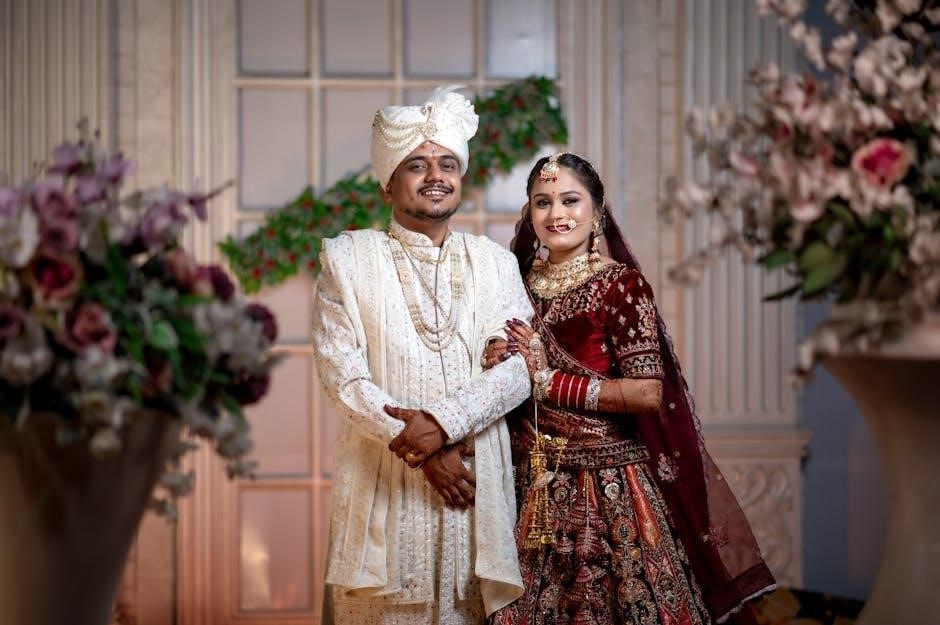
The term “Catholic,” derived from the Greek katholikos meaning “universal,” signifies the Church’s global and inclusive nature. This universality deeply informs the Rite of Marriage, practiced consistently worldwide, though cultural expressions vary.
Understanding this etymological root clarifies that a Catholic marriage, detailed in resources like a Catholic marriage PDF, isn’t limited by geography but embraces a shared faith and sacramental understanding.
Etymological Origins of the Word
The word “Catholic” originates from the Greek term katholikos, meaning “universal” or “according to the whole.” Early Christians used it to describe the Church as the entirety of believers, irrespective of location. This concept of universality profoundly shapes the Rite of Marriage.
Even resources like a Catholic marriage PDF demonstrate this consistent practice, reflecting a globally unified understanding of sacramental marriage, rooted in ancient linguistic origins.
The Universal Nature of the Catholic Church
The Catholic Church’s universality signifies its presence and consistent teachings worldwide, impacting the Rite of Marriage. Despite cultural variations, the core elements—consent, blessing—remain constant, as detailed in a Catholic marriage PDF.
This global unity ensures that a Catholic wedding in Rome shares the same sacramental foundation as one celebrated elsewhere, reflecting the Church’s all-encompassing nature.